Pete had asked me if I wanted to join him at Warkworth for a bit of transition flying in the Vintage Gliding Clubs Bocian VH-WUH. I readily agreed and arrived at HVGC today at 9 am.
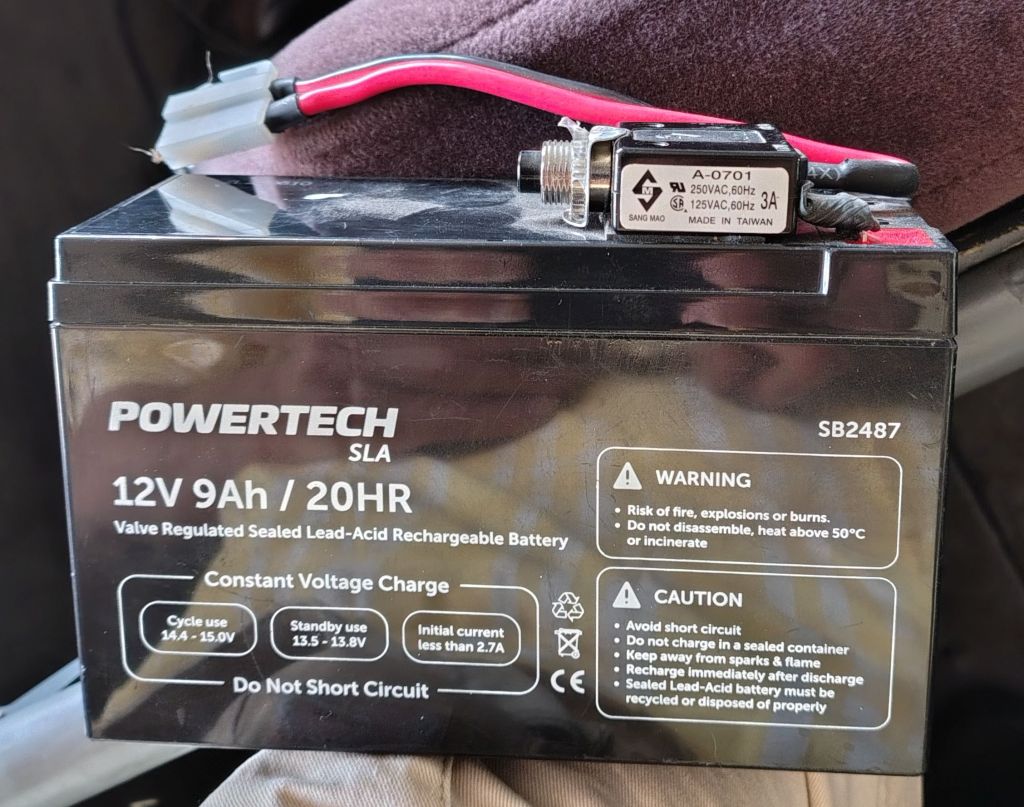
I was given the job of installing the battery on the luggage shelf, and soon realised this was not the easy task it is when the canopy is off (as it is with KYU at present). You have to climb into the back seat, turn around facing the tail and then contort your upper body under the rear canopy. I’ll have to have a think about this for KYU. It was interesting to note that Rob Moffat had arranged the battery holder so that the battery sits in it on end, not on its bottom as is the convention.
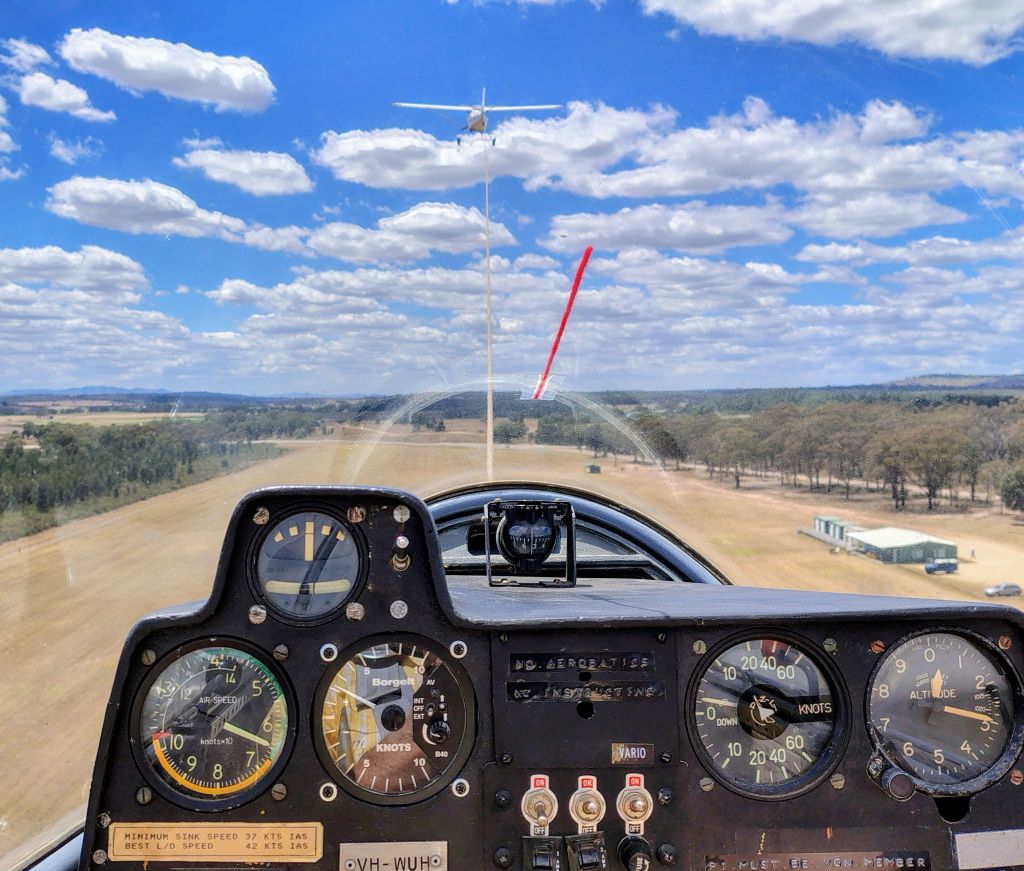
After a 9.30 briefing and general mucking around we launched behind HVGC’s Eurofox into the east about 12 noon.
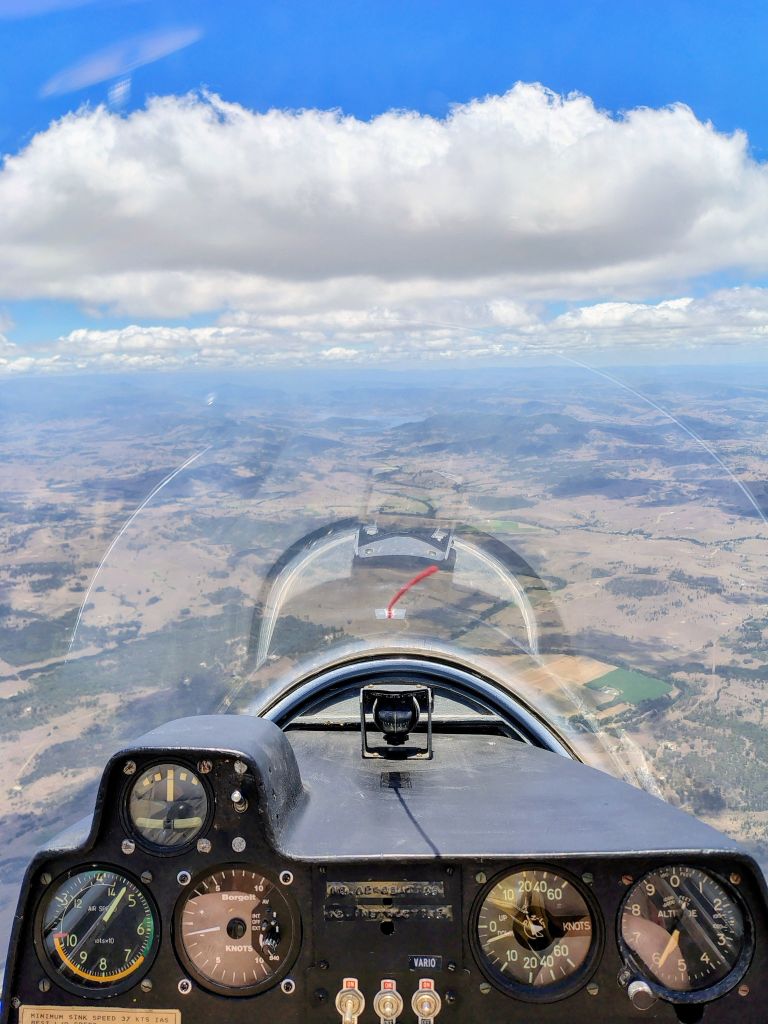
The sky looked quite fit for purpose. Releasing at about 1800′ into a thermal, we were soon above 5000′ which set the pattern for the day.
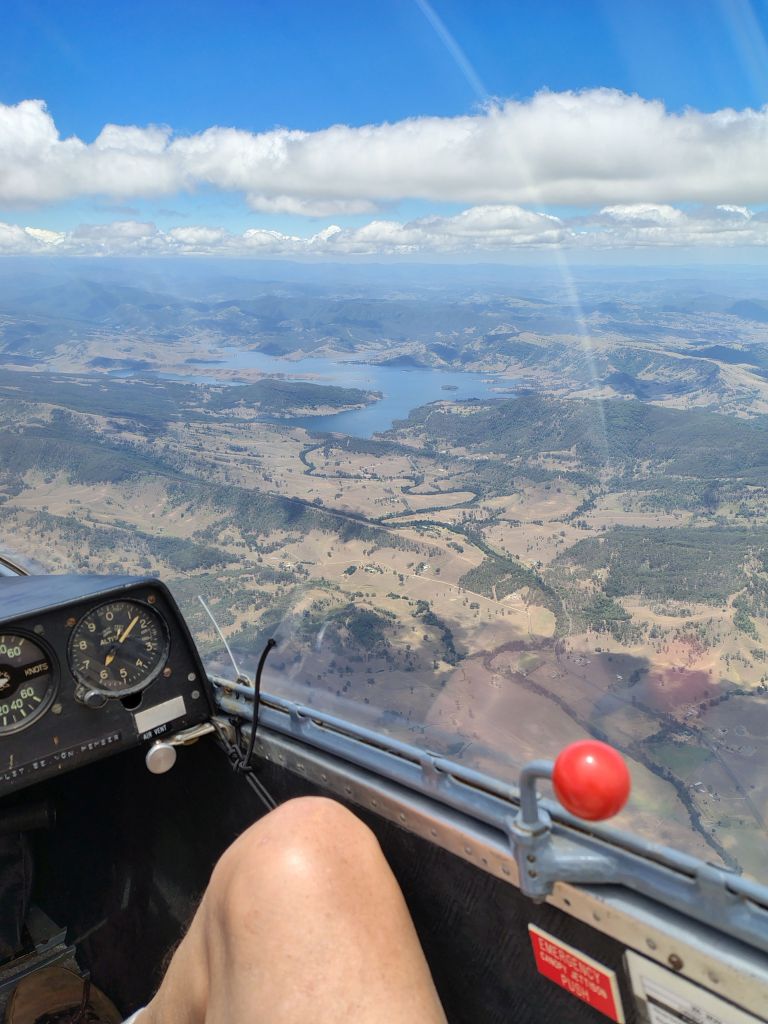
Before we took off, Pete announced that one of todays’ tasks would be to break the Bocian duration record for Warkworth which stands at just under 2 hours. After we passed this mark, we decided that we might as well put on a bit of additional margin for the next record attempt. This enabled exploration of the Hunter Valley, first across to Lake St.Clair and then up to somewhere north of Jerrys’ Plains.

Turning south from there we got a bit cocky with our inter-thermal speeds and got down to about 2500′ AGL. I’m using the royal plural here because when I pushed the nose down to about 60 knots Pete yelled “not so fast!”. So I asked what a good speed to fly between todays’ thermals might be, and the reply was “about 50, maybe 53 knots tops”. Yikes! I’d better get used to that rate of progress in a Bocian.
When we then tried to thermal up to a more comfortable height, we found that we just couldn’t get past about 3500′ despite the cloudbases and inversion still around 7000′. Since time was not of the essence (we actually wanted to waste it), we discussed at length what might be going on. In the end we theorised that there was a distinct wind shift from southwestish at height to eastish (due to approaching seabreeze) on the ground, which, coupled with some curl-over from the nearby ranges, was causing this “crack” in the thermals. After considerable scratching around we eventually were able to climb through this layer, back up to the 6000-8000 levels.
We shared the flying, handing over after every thermal, and it took me a while to get to grips with the peculiarities of WUH. I think the major issue is the need to have considerable backpressure on the stick to keep the thermalling speed below about 45 knots. In other words, the trim tab runs out of authoriy at around that airspeed. This causes the nose to wander from a nice constant horizon, which in turn upsets the rudder position at any particular speed. When keeping the speed at 45ish rather than 40ish, the situation noticably improved for me.
This problem had been discussed with Pete on many occassions before. It first became apparent when we found a lump of steel weighing exactly 1 kg bolted into the back of the fuselage of KYU, suggesting that the same issue had arisen with previous owners. Pete told us that they fitted 2 kg of lead into WUH to alleviate the lack of trim issue. I hate to think what it must have been like to fly for two “heavies” without that trim weight.
Pete lists 4 possible remedies in addition to putting more weight into the tail:
- Change angle of incidence of horizontal stabiliser down say 1 degree. This would be the prefered option as it would result in “cleaner” aerodynamics for the horiz. stab./elevator combo.
- Enlarge the trim tab to gain greater authority.
- Install a bungee bias setup, in principle similar to Tiger Moth standard elevator trim (which I copied successfully for my seaplane).
- Go on a diet..
We’ll see what Pete can come up with for WUH before considering whether to adopt the fix to KYU. I’m hoping that the lower weight of a Dieter/Laurie crew (about150 kg) compared to a Dieter/Pete crew (about 180 kg) might make an appreciable difference. Time will tell.
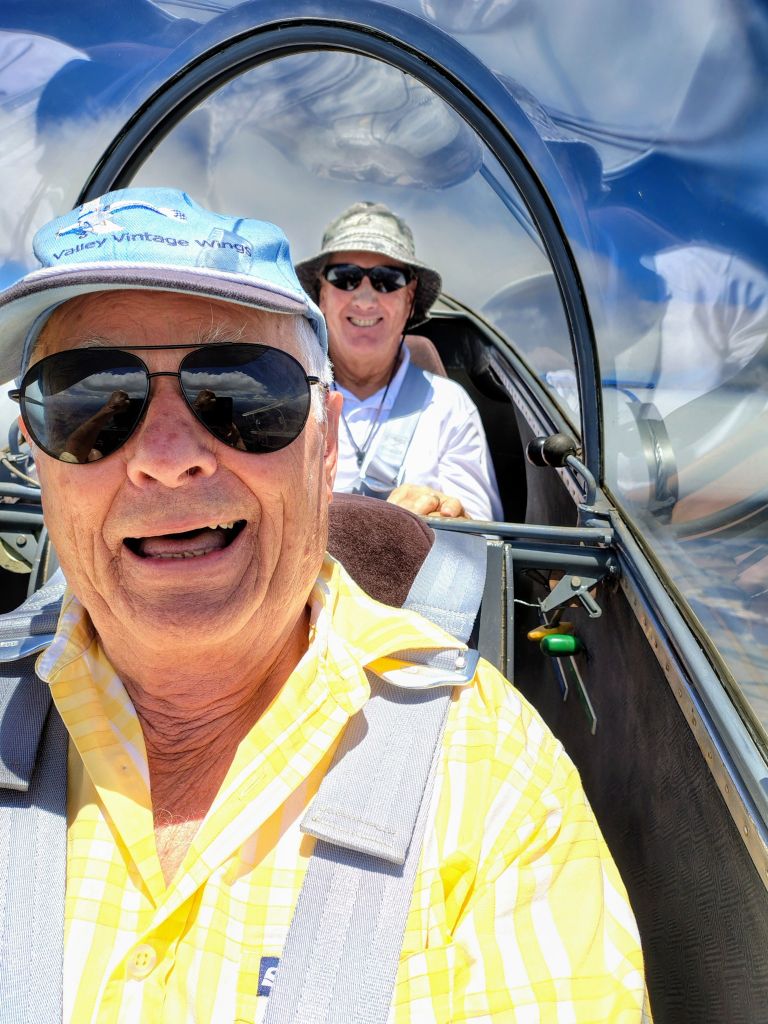
Enough theory! After about 4 hours 20 minutes, Pete asked whether I had enough by now, to which I suggested to maybe try for 5 hours, as I hadn’t done one of those in a proper glider for a long time. Without further ado we kept on racing between thermals at about 55 knots, going south as far as Paynes Crossing near Broke. About there the 10 knot seabreeze made itself felt, so by 5 o’clock we headed for home, landing after 5 hours 20 minutes and a distance of 198 km. I didn’t know Pete was putting this flight onto WeGlide, otherwise we could have added quite a few more km’s to the day.
So I’m now officially transitioned to fly both WUH as well as KYU when it’s finished.
 BOCIAN FLYERS
Leave a comment