We temporarily abandoned the fun job of acetoning the remnants of the Polyfiber chemistry off the ailerons, as a window of opportunity opened hwere St. Peter was able to induct us into the wonderful world of Oratex fabric covering.
While actually quite fun to do, there was a lot of stress involved in learning the various process steps required to convert the Oratex from a 5 x 1.8m roll of fabric into an airworthy cover for the structure of our Bocian. During these initial trials and tribulations, one is constantly aware of the consequences of a slip-up with either something sharp (scissors, craft knife) or hot (digital and detail iron, adjustable hot air gun.
We had coated the elevators, rudder and trim tab with glue beforehand to save a bit of time during Pete’s visit. It actually saved quite a bit of time since 2 thin coats are required, the second coat going on only after the first is completely dry. Because of the hot hot weather (30 degC) the drying only took maybe 20 minutes, but when it’s cooler the time increases substantially.
When Pete arrived we cut out the small piece of Oratex for the trim tab and coated the fabric with glue at the contact areas with the structure, again 2 coats with drying times between. Then Pete showed us how the fabric is “stitched” on at strategic points, starting at the centre and working to the outsides. The temperature of the iron for this process is about 100 degC. Then the glue on the fabric is melted into that on the structure while putting a moderate amount of tension onto the periphery while the melting process takes place. It takes both heat and pressure to create a satisfactory bond. The peel strength of that glue was previously tested as nearly 5 kgf on a 25mm wide test strip. The required strength according to the Oratex manual is 2.3 kg./25mm.
The manual suggests that the fabric glue lines for the ribs should be precisely matched to the actual ribs. However, since the ribs for the surfaces in question are only about 8mm wide, it is totally impossible to achieve that degree of precision with the glue onto the fabric. So Pete’s method is to add extra glue to the ribs which is the melted into the “dry” back of the fabric. An eminently more satisfactory solution compared to having excessively wide glue lines at the back of the fabric in an attempt to meet the thin ribs that way.
The wrap of Oratex gets really interesting (and challenging) at the ends, especially when there’s a radius involved. But event creating neat seams where the fabric is overlapped is not for the faint- hearted. One slip with the knife or scissors and there’s a drama in the making….
Once that wrap is finished, the fabric is heated at about 130degC which starts the shrinking and tightening part of the process. That’s actually highly satisfying to do and watch. I had forgotten since doing the wings on my seaplane with Polyfiber that this is the fun part of the job.
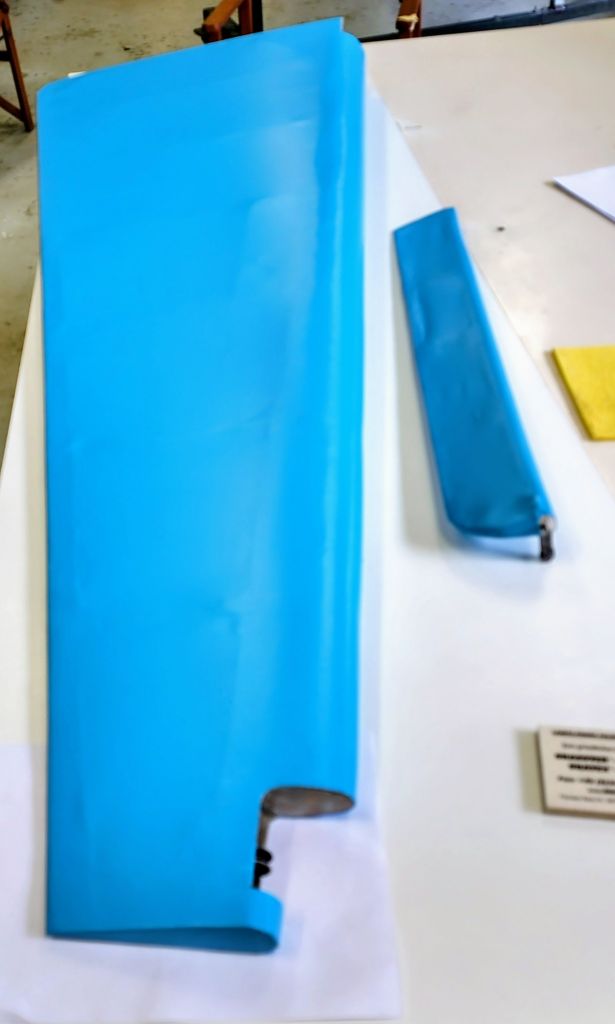
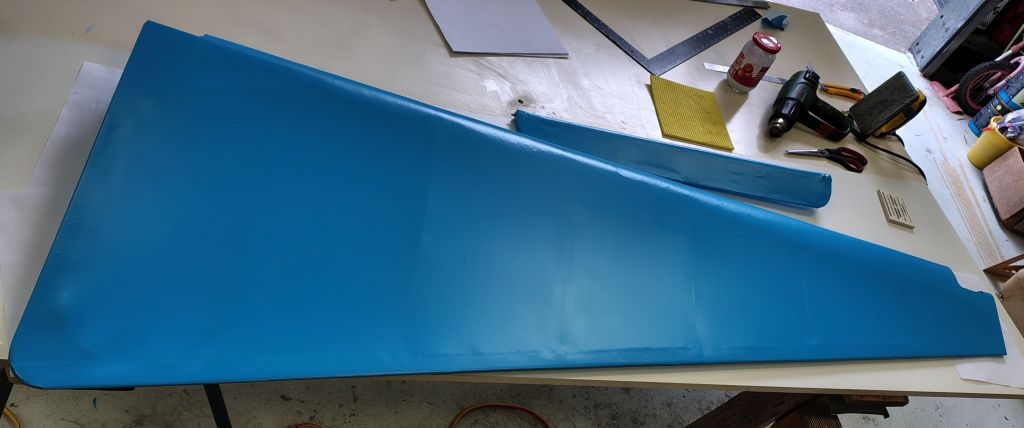
At the end of today we have a completed starboard elevator as well as the trim tab covered and pre- tightened.
 BOCIAN FLYERS
Leave a comment